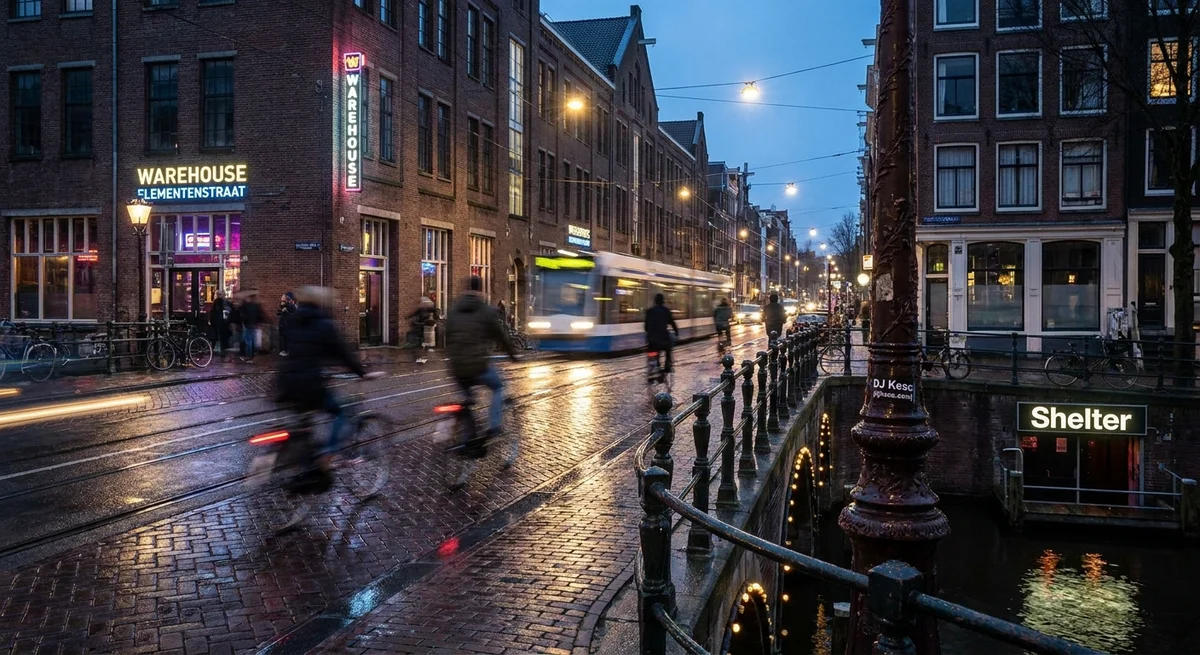
Amsterdam All Night: From Warehouse Elementenstraat to Shelter
Introduction
Amsterdam is famous for its lively all-night dance scene. In recent years the city has given special 24-hour permits to clubs. This has changed where and how people party at night (www.vice.com). The result is that electronic music fans can find late-night shows across many neighborhoods. A big reason for the scene’s growth is the annual Amsterdam Dance Event (ADE), when clubs book star DJs from around the world. In this article, we look at how the 24-hour licenses and city districts shape the nightlife, and profile seven key venues – Shelter, Warehouse Elementenstraat, Paradiso, Melkweg, Thuishaven, De Marktkantine, and Lofi. We describe their music styles, DJs and residents, sound systems, and door rules. We also point out how club spaces range from cozy rooms to giant industrial halls, mention local labels and radio shows, and how the bike-friendly city keeps the party going until dawn.
24-Hour License and Neighborhoods
Amsterdam began experimenting with 24-hour club licenses in 2013. Mayor Eberhard van der Laan even kicked off the first permit in a club by playing a famous Detroit Swindle track (www.vice.com). After the trial, the city decided to extend later hours, but mainly outside the old city center (www.vice.com). This was on purpose: the rules said that only clubs in the outskirts (industrial or empty lots) could apply for 24-hour opening (www.vice.com). Famous central venues Paradiso and Melkweg, meanwhile, already had special permissions to stay open up to an hour after the last act (www.vice.com). As a result, much of Amsterdam’s dance culture moved toward new hotspots in Amsterdam-West and -Noord (north) instead of crowding the historic center. For example, Shelter opened under the A’DAM Tower in Noord, Warehouse Elementenstraat and De Marktkantine set up along the western harbor, and Lofi launched near Sloterdijk in Westpoort (elementenstraat.nl) (ra.co). This spread keeps late-night crowds more balanced across the city. Even so, party-goers in the old center can still stay out late on special occasions: Rembrandtplein’s bars and clubs are allowed to extend hours on big party nights, and Paradiso/Melkweg can run shows later than normal (www.vice.com) (www.vice.com).
Amsterdam Dance Event Influence
Every October, the Amsterdam Dance Event (ADE) takes over the city. ADE attracts international DJs, promoters, and tens of thousands of fans. During ADE, most of these clubs host marathon events, back-to-back parties, and special label showcases. For example, Warehouse Elementenstraat regularly appears on the ADE venue list, home to big names like Hyte, Welcome to the Future, Reaktor and Luciano & Friends (www.amsterdam-dance-event.nl). Shelter and De Marktkantine also put on multi-day ADE showcases. Even Paradiso and Melkweg book extra electronic nights around ADE through their club divisions. Local resident crews and radio labels often tie into ADE events – live-streaming sets or teaming up with clubs for parties. In short, ADE raises room bookings across the board and makes Amsterdam a global dance center in October.
Cycling and Getting Around
One reason Amsterdam’s late nights work so well is that the city is made for cycling. Locals regularly bike home at dawn: “These days people have no problem cycling” even out to riverbanks and wet docks, notes Paradiso programmer Maz Weston (www.vice.com). In fact, guests can often ride a bike or take a late ferry for free (night ferries across the IJ run all night). By contrast, 30 years ago some venues needed to run party buses for ravers (www.vice.com). Today the extensive tram and metro network also keeps running after midnight (at reduced schedules), so public transit and cycling both help night owls get home safely.
Shelter (Amsterdam-Noord)

Shelter is an underground techno temple tucked beneath the iconic A’DAM Tower in Amsterdam-Noord (www.iamsterdam.com). It sits on Overhoeksplein, across the river from Central Station. Shelter first opened in 2015 and quickly became known for heavy techno and marathon all-nighters. In February 2024 it reopened after a major renovation (ra.co). The makeover added a new LED ceiling and a second smaller room, allowing the club to mix different dance music styles more flexibly (ra.co) (ra.co). Tonight the sound is top-notch: Shelter’s 700-capacity main room uses a four-point Funktion-One system (with Evo-6 mid/high speakers and twin 21″ subwoofers) (www.prosoundweb.com).
Shelter bills itself as devoted to “underground electronic music” (www.iamsterdam.com). Its programming now spans a bit more: longtime techno alongside house and disco sets, vinyl throwbacks and forward-looking beats. For example, Shelter’s reopening lineup in 2024 featured acts like Krystal Klear (house), Gerd Janson (nu-disco), Jennifer Loveless and Black Loops (tech-house), reflecting its multi-genre approach (ra.co). The club has no fixed DJ roster (no one resident dominates), but a fluid crew of Dutch and international DJs emerge regularly on night bills. Shelter enforces a strict, respectful door policy. Aggression, large unruly groups, or discriminatory attire (like explicit slogans on clothes) are immediate grounds for refusal (lofi.amsterdam). Bags may be searched to ensure a safe vibe. Inside, Shelter is cashless – all drinks are paid by card – and phones are discouraged to keep focus on the music. In sum, Shelter offers an intense, inclusive party space: relatively intimate compared to festival venues, but still big enough (up to ~700 people) for a full rave thrill (www.prosoundweb.com).
Warehouse Elementenstraat (Amsterdam-West)
Warehouse Elementenstraat is a massive multi-room club in West Amsterdam. It occupies a former peanut factory beside the old harbor docks (elementenstraat.nl). In the early ’90s this same building hosted illegal gabber raves, but it was shut down by police in 1993. Two decades later, Weekend Festival founder Duncan Stutterheim revived the site. From 2012–14 he rebuilt it into a modular club “concrete maze” with multiple rooms and a powerful new sound system (elementenstraat.nl). Today the Warehouse has four halls with a total capacity around 2,500 (www.iamsterdam.com). This means it can host events as big as indoor festivals, yet each room remains navigable. You might hear ambient chill in a small booth one room and pounding techno on the main floor.
The Warehouse is home to some of Amsterdam’s most famous dance brands. For years it has hosted Hyte (David Morales’ deep house party), Welcome to the Future, Reaktor, Soul Project and Luciano’s sets (www.amsterdam-dance-event.nl). During ADE and summer seasons it is packed with international headliners and local legends alike. The sound setup at Elementenstraat is very serious: they chose Funktion-One (after testing four systems) (think-av.nl). Each side wall stacks Evo7 loudspeakers and F221 double-21″ subs for big impact. The goal is a deep, clubby sound no matter which room you’re in. With that audio and its eight-drum monitors, the Warehouse delivers the kind of audio clarity usually only found at major festivals (think-av.nl).
Door policy at Elementenstraat is professional but friendly. Security checks IDs and performs bag searches, as standard in large clubs. Since the neighborhood is industrial it’s far from residents, so late nights rarely cause complaints. Most nights are 18+ (with occasional 16+ parties). The vibe here attracts free-spirits and veterans: it’s the place to dance hard, whether you’re a local or international partygoer.
Paradiso (Amsterdam-Centrum)
Paradiso is a legendary Amsterdam venue in the old city center. Housed in a converted church (Weteringschans area), Paradiso opened in 1968 as a “Cosmic Relaxation Center” for arts and music (www.paradiso.nl). Over the decades it became a pop venue, club and cultural center all in one (www.paradiso.nl). Today Paradiso has a large Main Hall (capacity ~1,500) plus two smaller halls upstairs (250 and 150) (www.podiuminfo.nl). Unlike the strictly electronic clubs, Paradiso books a broad program: rock, indie, world music, and yes, some DJ-led dance nights under “Club Paradiso” and related nights.
Paradiso’s sound and atmosphere are concert-grade, befitting its half-thousand-seat hall. The stage area and lighting are designed for shows, not purely clubbing, but top DJs do spin there (often drawing in crossover crowds). Because it’s central, Paradiso was not eligible for the 24hr license, yet it can run late under city rules. In fact, for many years Paradiso has been able to legally stay open until one hour after the last act (www.vice.com). However, neighborhood noise is a constant issue. Paradiso has been negotiating with neighbors to add better entrances and sound-proofing. (In 2026 it plans a major rebuild: the club announced it will close for about six months to renovate and expand, improving the late-night entrance and layout (nltimes.nl).)
Door policy: Paradiso tends to be open and diverse. It does not regularly do strict searches unless a show is that kind of event. Entry is often via a side tunnel under Leidseplein that minimizes street queues. After entry, drinks are affordably priced, and security staff are present (as at any busy club) to scan IDs and keep the party safe. Evening programs usually start very late: doors may open just before midnight for dance nights, and the club can stay open well past 3–4AM on weekends, thanks to its extension license (www.vice.com).
Melkweg (Amsterdam-Centrum)
Melkweg (Dutch for “Milky Way”) is another major Amsterdam cultural center and music venue. It sits at Leidseplein, very close to Paradiso. Like Paradiso, it transformed from a non-religious meeting hall into a big concert and club venue. Melkweg’s largest hall (“The Max”) holds about 1,500 people; a second hall (“Oude Zaal”) holds ~700 (www.podiuminfo.nl); plus there is an intimate theater (112) and a small cinema (90) (www.podiuminfo.nl). The sound in Melkweg’s main rooms is high quality (Martin Audio equipment) – enough so that rock bands or large DJ acts don’t strain the system (www.mixonline.com).
Melkweg’s programming is eclectic: live bands, DJs, theater, art exhibitions, youth events, etc. On the club side, it hosts genres like hip-hop, R&B, techno, and soul under the branding of its urban or dance nights (often in partnership with radio crews like Red Light or Soulzza). During ADE you’ll also find Melkweg packed with international DJs on weekend afternoons/evenings. Melkweg was also given a special late-night license along with Paradiso (the “hour after last act” rule) (www.vice.com). Since it’s so central, it keeps to sound curfews on school nights, but on weekend ADE-style parties it can play deep into the night. The crowd at Melkweg is mixed – from avid clubbers to concert-goers. Door staff watches for troublemakers as usual, but Melkweg prides itself on openness and broad culture; it is more of a community hub on weekend afternoons and a nightclub after midnight.
Thuishaven (Amsterdam-Westpoort)
Thuishaven is a unique outdoor club in Amsterdam’s far west harbor area. It bills itself as “not a club or a warehouse, but a unique experience” (www.amsterdam-dance-event.nl). Thuishaven’s site is surrounded by shipyards, oil tanks and scrap metal, giving it a raw, industrial vibe. In summer it opens a massive open-air stage for techno/house raves, and in winter it turns on heated tents and hangars so events can still run late (www.amsterdam-dance-event.nl). The venue has multiple stages and bars, decked out with surreal decor often made from found scrap (www.amsterdam-dance-event.nl). In total the area can hold several thousand people (the city permit for events is for ~3,500) (drimble.nl).
Thuishaven is usually open as an afternoon-into-evening venue (e.g. events from 1PM to near midnight). It often does beach-party style or festival-style events with headliners in a variety of house and techno genres. Its clientele skews young and adventurous – many commute by ferry (the NDSM ferry from Central stops here) or by bike. Since it’s miles from homes, it can run parties until the morning without complaints. This open-air party yard closes after summer but reopens in early spring, often with marathons (24+ hour) events around ADE. In ADE listings, Thuishaven features big names (for example, Defected or Glitterbox have thrown parties there) (www.amsterdam-dance-event.nl). Staff and door policy on site are flexible: as long as you have a ticket and behave, you’re usually free to roam from stage to stage. The biggest rule is that drinks and smoking are confined to outdoor areas, as might be expected.
De Marktkantine (Amsterdam-West)
De Marktkantine is a retro-industrial club on Jan van Galenstraat (near the Food Center). It was built in 1936 as a market canteen, later a theater, and in the ’90s a nightclub. After closure and vacancy, a group of locals reopened it in 2014 (www.amsterdam-dance-event.nl). The club kept its art-deco/industrial look but refurbished it. The main room (a theater-style space) now holds about 1,200 people; an adjacent smaller club room fits about 300 (www.amsterdam-dance-event.nl). This split makes for a big dancefloor and a more intimate side-floor.
Marktkantine’s focus is house, techno, and lively club nights on weekends. International DJs (for example Ben Klock, Tale Of Us, Ame) often headlined its ADE-era events, while Dutch collectives run it on local club nights. The sound system is Funktion-One, so it hits hard and clear. Door policy is firm: it’s a popular club, so there can be a queue of young adults waiting, and dresscode is usually “casual”. ID is checked, no phones on the dancefloor is encouraged, and loose items get a quick pat-down. Because it’s off the beaten path, guests often come by bike or short taxi, and leave in small groups at 5am when it closes on the dot. So Marktkantine feels like a local party(base) with some festival energy.
Lofi (Amsterdam-Westpoort)
Lofi is a versatile new club located at Basisweg 63, in the Sloterdijk/Westpoort district. It opened in October 2019 (ra.co) in a remodeled old bus garage, aiming to inject new life into Amsterdam’s free-spirited nightlife (lofi.amsterdam). Lofi’s space is raw and graffiti-styled indoors, with an open courtyard outside for summer hangouts. The club bills itself as hosting everything from warehouse raves to intimate community gatherings on the courtyard (lofi.amsterdam).
From its first season, Lofi has drawn respected names in underground music. DJs like Rhadoo (Romania), Tama Sumo (Germany), Beta Librae, and Jeremy Underground (Paris) have played there (ra.co). Its style is open-format underground house and techno, with occasional disco or acid sets, but no overbearing corporate feel. The crowd is a mix of local Dutch ravers and international visitors. Lofi’s sound is well-liked (multiple Funktion-One stacks have been mentioned), and its floor is hardly ever empty on a club night.
The doors at Lofi enforce inclusivity. The house rules stress respect: no hate, no harassment (lofi.amsterdam). They explicitly ban hate slogans or football jerseys – the goal is a welcoming vibe. Guests are usually 18+ (though daytime/kids events can be younger). Lofi is cashless like Shelter, and staff will search patrons if they suspect misuse of substances. Photo-taking is allowed on the floor (phones okay for personal use), but the crew asks people not to dance behind the DJ booth as usual. Finally, Lofi runs into the early morning (some ADE specials have run from afternoon straight through dawn). Because it’s outside the old center, it can party past 4am and still be law-abiding.
Local Labels and Radio
Amsterdam’s club culture is also fed by local record labels and radio stations. Homegrown labels like Rush Hour, Clone, Delsin, and Dekmantel (though Dekmantel is more festival) nurture local DJs who play in these clubs. Meanwhile, internet radio streams amplify the scene. The best-known is Red Light Radio, a pirate-style station launched in 2010 out of a former brothel in the Red Light District. RLR boasts an extremely diverse sound policy – from “the obscurest afro to the newest electronica” and everything in between (wepresent.wetransfer.com) – and thousands of fans worldwide. It even runs live club sets and a small festival. Another local station is Noods Radio, focusing on Dutch minimal, house and experimental sounds. These stations broadcast DJ sets from Amsterdam’s city clubs (and beyond), so even if you’re not at a party, you can tune in to the city’s vibe.
Cycling and Late Nights
Finally, Amsterdam’s bike culture makes late-night travel easy. Virtually every corner bar or club has a bike rack, and cycling lanes reach deep into Noords and Westpoort. After hours, free ferries around the harbor also help you get home on two wheels. As noted above, it’s common to see partygoers cycling home at dawn (www.vice.com). If biking is not your style, the GVB night bus network will get you downtown most nights (though service is sparser). In any case, the split between big industrial spots and cozy inner clubs means you can plan a crawl that mixes gritty warehouse beats with the snug vibe of a city-center venue.
Conclusion
Amsterdam’s nightlife now truly stretches “all night”. Thanks to the 24-hour license scheme and the international boost of ADE, parties can continue from sunset to sunrise in many parts of town. Clubs like Shelter and Warehouse Elementenstraat represent the new-school side – raw venues lit by LED and Funktion-One sound, where DJs play straight through the night. Classics like Paradiso and Melkweg remind us of the city’s cultural roots and blend concerts with club nights. Open-air Thuishaven brings the festival spirit, while Marktkantine and Lofi mix industrial charm with underground beats. Together, they offer almost every style of electronic music, each with its own resident DJs and atmosphere. For visitors, that means they can cycle or transit between very different scenes in one night. And with local labels and radios streaming the sounds, Amsterdam’s music never really stops.