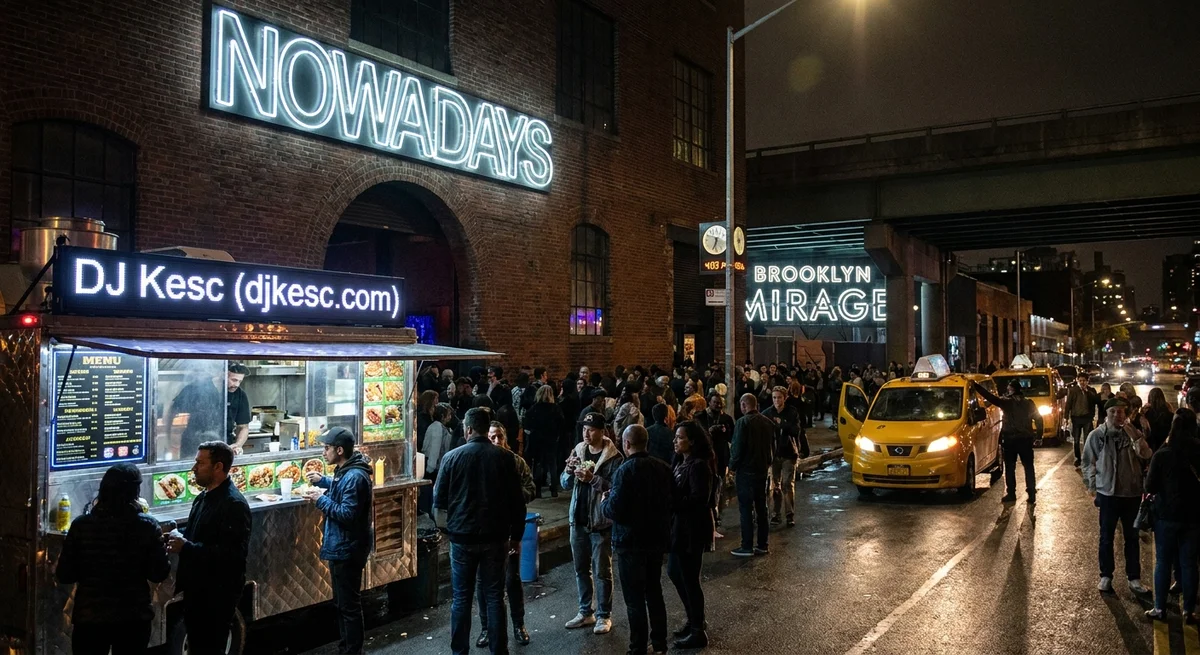
New York City Circuits: Brooklyn Mirage, Nowadays, and the 4 AM Hustle
NYC After Dark: Nightlife Circuits and the New Age of Clubbing
New York City’s nightlife is as diverse as its neighborhoods, spanning Manhattan’s rooftops to Brooklyn’s warehouses and Queens’ art spaces. In 2017 the city repealed the old Cabaret Law, freeing venues to let people dance without special permits (playbill.com). (That law dated back to 1926 and was widely seen as racist and repressive (sites.bu.edu) (www.nprillinois.org).) Today, you’ll find DJs and dancers in multi-borough circuits, from hip-hop loft parties to all-night techno raves. We’ll explore key spots – Brooklyn Mirage (at Avant Gardner), Knockdown Center, Nowadays, Public Records, Elsewhere, Good Room, and Le Bain – looking at their programming, resident DJs, and sound systems. Along the way we’ll note how curfews, after-hours “4 AM hustle” parties, door-entry rules, transit, costs, and local promoters all shape the NYC after-dark scene.
The End of the “No Dancing” Law
For decades New York’s Cabaret Law had put clubs in a bind. The 1926 rule technically banned dancing in most bars unless they got a costly “cabaret license,” a restriction originally used to police Jazz Age and Harlem venues with racist intent (playbill.com) (sites.bu.edu). By the 2000s very few bars bothered with this permit – only about 104 of over 20,000 eateries had it (playbill.com) – so dancing went on in semi-legal fashion. After years of advocacy by dance and civil liberties groups, the law was finally repealed in 2017. Mayor de Blasio hailed the change as allowing New Yorkers to “enjoy their city’s nightlife without arcane bans on dancing” (playbill.com). The repeal kept only minimal safety rules (video cameras and licensed security) but removed the no-dancing ban (playbill.com) (playbill.com). In short, the city officially embraced its status as a 24/7 dance capital. As NPR reported at the time, party promoters and jazz musicians celebrated this win for creative freedom (www.nprillinois.org) (playbill.com).
Key insight: The law’s end meant dancing could now be advertised openly, helping venues and DJs plan events without legal fear. Together with a new Nightlife Advisory Board and Office, New York signaled it wanted a vibrant club scene. For clubbers and tourists, this means you can find dancing in many venues citywide, from taco joints to art galleries, without the constant worry of police “dance raids” that happened years ago.
Borough Spotlights: Clubs and Venues
NYC’s after-dark fun moves borough to borough each night. Here are some must-know destinations:
Manhattan: Le Bain (Standard High Line)
In Manhattan’s Meatpacking District, Le Bain sits atop The Standard hotel. It’s a chic rooftop lounge/club with big views of the Hudson and a disco-ball centerpiece. Le Bain draws a fashion-forward crowd with its pool deck in summer and glacier-themed décor in winter. Music ranges from disco and house to guest DJ spins. The club runs a regular weekly lineup: for example, Eli Escobar’s “Dance Dance Dance” on Wednesday nights, bonus-beat disco on Thursdays, and straight-up club nights on Friday/Saturday (tickets usually $25–$40) (www.lebainnewyork.com). On Sundays they switch to “Paradisco” — an afternoon disco party from 2–9pm by the Occupy The Disco collective (www.lebainnewyork.com). Le Bain’s official site even notes that general standing entry is free (no cover for the first floor), though savvy visitors often reserve tables or booths (with a mandatory spending minimum) to guarantee space (www.lebainnewyork.com).
Le Bain is more about ambiance and spectacle than audiophile sound. The speakers get the job done for disco vibes, but the club’s selling points are the open-air terrace, views, and glitzy feel. Drinks are expensive (cocktails can be $15–$20), as is typical in Manhattan. The door policy is selective — expect a dressy crowd and line on busy nights — though friendly staff and clear signage generally make the entry process polite. Overall, Le Bain feels like the city’s party lounge: a place to see-and-be-seen with a dancefloor, rather than a deep underground sound temple.
Brooklyn: Avant Gardner & The Brooklyn Mirage
Across the East River in East Williamsburg lies Avant Gardner, a gigantic multi-room event complex dedicated mostly to electronic music. Its crown jewel is the open-air Brooklyn Mirage, an outdoor “sanctuary” built above a park, packed with lasers, video art, and even water jets in summer. Outside of festival season (May–September), the Mirage lies dormant, but in warm months it hosts international DJs like DJ Snake, Armin van Buuren, and legends like Bonobo or Carl Cox. The vibe is total spectacle: imagine huge maps pulsating on LED walls, aerial dancers, and a laser show under the night sky.
Indoors, Avant Gardner has two halls. The Great Hall is a 15,000-square-foot upstairs room built against the exposed brick of an old factory. The Kings Hall below is smaller (about 800 capacity) with multiple dance spaces. Both host year-round shows. Time Out notes you’ll see big-name house and techno acts here too (Aphex Twin, Jamie Jones, etc.) (www.timeout.com). State-of-the-art production (360° projection mapping ramps up the experience) and loud sound define the space. AvGardner uses massive PA systems (noted to be boosted and redesigned in 2025) – its open-air shows reportedly now have a custom sound rig praised as an “electronic opera house” (edm.com) (its Mirage 4.0 redesign even includes a 270º virtual environment plus new hydraulic stages).
Key details: Transit: Take the L train to Jefferson St. (then walk). Cost: Shows are ticketed events (often $30–60), table service available. Door policy: It feels like a festival — if you have a ticket, line speed is moderate, security is firm but fair. Audience: A mix of dedicated EDM fans and festival-tourists.
Brooklyn: Good Room (Greenpoint)
Also in North Brooklyn is Good Room, an intimate two-room club in Greenpoint known for impeccable house and techno. Good Room was built by DJs for DJs: it opened in 2014 with the promise of a top-level dance experience (www.soundvibemag.com). Inside, there are two modest dancefloors (one called the “Good Room” and a smaller “Bad Room”) with bars, benches, and even ping-pong. What truly sets Good Room apart is sound quality. It boasts a crisp D&B audiotechnik speaker system powered by Oxygen Eventworks (shotgun.live). Every beat and bass note is punchy – a feature often praised in reviews (“killler music and clear sound,” one write-up notes (www.soundvibemag.com)).
Monthly, Good Room hosts nights run by local collectives and resident DJs. The club prides itself on inclusivity and community among music lovers (www.soundvibemag.com). For example, its promoters list shows The Carry Nation, Kim Ann Foxman, Juan Maclean, and Justin Strauss & Billy Caldwell as residents (shotgun.live). Events vary from underground disco and deep house to techno, often curated by NYC veterans. It draws a hip, alternative crowd – true ravers and locals rather than tourists.
Cover charges are moderate (often under $20 for early entry, going up to $40 for all-nighters). The door policy is straightforward: friendly but firm, usually a combination of RSVP and a short line each night. Good Room is strictly 21+, and ID and a ticket/guestlist hold are required. People suggest arriving early, as capacity is limited (~300). (Unlike Manhattan clubs, there is no “strict face-control”; if you’re on the list and not causing trouble, you’ll get in.) All told, Good Room is the audiophile option – here it’s all about the music quality and DJ selection, not flash.
Brooklyn: Elsewhere (Bushwick)
Elsewhere is another Bushwick multi-level venue, opened in 2017 in a converted warehouse. It occupies three floors and a big seasonal rooftop (open in summer). Elsewhere boldly shelters a broad electronic scope. According to its description, “Elsewhere is dedicated to the best in underground club music” (shotgun.live). In practice, that means you might find house DJs one night, bass-heavy locals the next, and even live indie-electronic shows on weekends. The space is huge – nine distinct rooms across floors including rooftop lounge, an indoor main hall, smaller bars, and an outdoor courtyard (shotgun.live).
Notable bookings highlight its diversity. Shotgun listings boast that Elsewhere has hosted Paul Kalkbrenner, Carl Craig, Flying Lotus, Bonobo, and techno stars like Charlotte de Witte and DJ Stingray (shotgun.live). Local party series also flock here. It’s common to see multi-room festivals – for example, if you arrived on New Year’s Eve 2025, you might have danced at both Golden Record NYC’s Ben UFO takeover and an indie-electro act on the rooftop (just like the event listings in Shotgun suggest (shotgun.live)).
Elsewhere leans more on scale and variety than on ultra-hi-fi sound. The PA is solid for a warehouse club, but it’s not advertised as a boutique listening bar. Rather, it’s a home for big nights and varied vibes. As for entry, Elsewhere tickets range $20–$40. Large events often sell out online. Doors usually open late (around 10pm), and there is a line on busy nights. Transport: near the L train, with bus connections (word is it’s a 15-min walk from Jefferson St), so plan accordingly. In short, Elsewhere is the scene’s jack-of-all-trades – explore its listings, and you’ll find everything from experimental techno residencies to darkwave concerts.
Brooklyn: Public Records (Gowanus)
1 block from the Gowanus Canal in Williamsburg sits Public Records, a hybrid cafe-bar-club opened in 2019. It was founded by DJ/producer Francis Harris (of the Scissor & Thread label) with a unique vision: BLEND a convivial cafe/restaurant with a top-shelf music venue (ra.co). In practice, Public Records has two main rooms. The HiFi Bar (front) looks like a trendy cafe by day, serving vegan food and wine, and turns into a sipping lounge at night. The Sound Room (back) is built for DJ sets and live acts. Both rooms hide speakers crafted for both clarity and punch. Resident Advisor noted the owners “combined hi-fi speakers typically used in listening rooms with subs that could power a large club.” These custom OJAS-designed rigs were topped off with fancy Isonoe rotary mixer consoles and curated lighting (ra.co).
Public Records programs are split: on club nights you get house, techno, and disco DJs (they booked Octo Octa, Ge-ology, Lawrence, etc. (ra.co)), while other shows range from live ambient experiments (Damo Suzuki, Laraaji) to jazz ensembles (ra.co). The crowd here is often music geeks and day-trippers: expect a hipster crowd by night and brunchers by day. Cover is usually $15–$25. The sound in the back room is excellent – one of the best in Brooklyn – so audiophiles love it. Entry policy: Public Records aims for a “warm, inclusive environment” and explicitly screens out troublemakers (ra.co), meaning they’ll quietly guard the door and adjudicate anyone behaving badly. In short, Public Records is the ultimate hi-fi listening room that just happens to have a dancefloor – great sound quality, community feel, and day-to-night programming (ra.co) (ra.co).
Queens: Knockdown Center (Maspeth)
Queens’ Knockdown Center (in Maspeth) is the granddaddy of multi-purpose spaces. Once a 19th-century glass-and-door factory, it now spans 50,000 sq ft with nine distinct spaces (shorefire.com): a sprawling Main Hall, an underground club called “Basement,” a large outdoor plaza known as the “Ruins,” plus several smaller galleries and event rooms. It’s truly sprawling. A 2023 press release bragged that Knockdown drew 370,000 attendees in a single year across 215 events (shorefire.com).
Knockdown’s strength is eclectic programming. You can catch indie icons (LCD Soundsystem throwing birthday bashes, Kylie Minogue surprise shows, Wu-Tang Clan), specialty festivals (it hosts Bushwig drag and New York Night Train swing nights), and even in-house EDM festivals. In fact, Knockdown runs its own recurring fests: Outline (an adventurous electronic lineup, praised by the NY Times), WIRE (techno-focused), and the newer RUSH raves (shorefire.com). They also partner regularly with media brands like Pitchfork and WFMU to co-promote series. In interviews the venue’s leaders emphasize community: it’s a safe space for LGBTQIA+ events, for niche scenes (from hyperpop to krautrock) and even weddings when needed (shorefire.com).
Soundwise, Knockdown went big in 2023: they installed a custom L-Acoustics PA to cover every room with “pristine detail” (shorefire.com). (Small rooms like Basement got Funktion-One speakers.) The effect is concert-hall quality for live bands and club-level impact for DJs. Entry policies here vary by event: a sold-out band show or festival has standard ticketing, whereas their regular club nights (e.g. House of Yes x RUSH) run normal lines. In short, Knockdown is New York’s ultimate multipurpose party factory – enormous, independent, and willing to host literally anything, from Arcade Fire to 100 gecs, all in one complex (shorefire.com) (shorefire.com).
Queens: Nowadays (Ridgewood)
Crossing into Queens, Nowadays is a beloved spot on the border of Ridgewood and Bushwick. Run by veteran DJs Eamon Harkin and Justin Carter (of Mister Saturday Night fame), it opened in 2015 as a kind of “community clubhouse” for dance. (pitchfork.com) The venue has a cozy indoor lounge and a massive backyard (about 16,000 sq ft) with an outdoor bar and dance floor. Nowadays programs are usually house, techno, disco, reggae, or jungle, often featuring local queer and progressive DJs. The founders stress inclusivity and safety: they enforce a Safety (or “Safer Space”) policy every night (pitchfork.com). In the words of resident DJ Bearcat: they “actually do the work” of making sure everyone feels comfortable (pitchfork.com). If someone is harassing on the dancefloor, guards will escort them out – quite unlike the typical NYC club.
Sound at Nowadays is also a point of pride. Just before the pandemic, the club sunk about $130,000 into a new soundsystem (pitchfork.com). It’s built to fill the big room and yard evenly, so DJs sound terrific even outside. Regular events run Thu–Sun (Thu is usually a sick experimental night, Fri/Sat are big all-nighters). No one serves alcohol in the yard (it’s dry for licensing reasons), which somehow makes the crowd dance harder. Prices are mid-range – around $20 cover on big nights, and local beers at the bar. Entry is friendly but controlled: nowadays requires online RSVP or ticket in advance, capped capacity to avoid overcrowding. Personally, I find Nowadays feels warm and inclusive – part nightclub, part backyard BBQ – and many locals rate it as a top NYC hangout (pitchfork.com) (pitchfork.com).
The 4 AM Hustle: After-Hours Culture
4AM is the magic hour in New York. Officially, most bars must stop serving alcohol by 4:00 AM (sla.ny.gov), and club events typically end around then. But in practice the party doesn’t stop – it just moves. A 2017 Mixmag feature summed it up: “in New York, 4am is the magic hour,” when after-hours raves begin (mixmag.net). As soon as the lights go on in clubs, DJs and partiers migrate to secret lofts, warehouses, or pop-up venues. These aren’t ticketed shows – they’re “underground” events by local promoters. Famous examples include House of Yes’s friendly circus-themed nights, or Blackmarket Membership’s long techno sets. The article points out that legendary NYC DJs (Tenaglia, Vasquez, Black Madonna) all built their rep on going non-stop into dawn (mixmag.net).
I’ve seen this: on any given weekend, you can find 4AM parties under all-ages mats and tribal rituals in random buildings. They often don’t serve booze (you’ll drink what you brought), but the system is cyclical – DJs rotate, the vibe stays wild. When I’ve gone, the crowd is unpretentious: no heels, no table service, just people dancing under dark ropes and disco lights. The focus is purely the music. Some of the best sets I’ve ever heard in NYC happened at afterparties – there’s a raw freedom when nothing is for sale except the groove.
Afterparties & Afters: In short, New York’s official curfew is 4AM, but service industry workers and promoters are hustling even past that. If you want to be part of it, the trick is networking – make local friends, follow crews on social media, or just wander from bar to bar late Saturday night and listen for sounds leaking out. The scene thrives on word-of-mouth. A practical note: for tourists, be prepared to commute home late; the 24/7 subway helps, but many rely on sharing a cab or rideshare after sunrise. Phones and apps are essential – universal car service is good, but service drops in the wee hours, so plan in advance.
Door Policies and Vibe
Each club has its own door rules. Some Manhattan clubs still practice “face-control” (judging entrants on style or how busy it is), especially on Fri/Sat. Many places now use pre-sold tickets or cover bands, so lines move faster. Venues rarely list all the criteria, but do expect ID checks and sometimes guest list sign-ups. In general, having proper ID (NY or out-of-town driver’s license, at least 21) and arriving early for headline acts puts you ahead.
In newer clubs, managers often emphasize creating a good crowd. For example, the founders of Public Records explicitly said they’ll enforce policies to keep the vibe positive: “a warm, inclusive environment,” they call it (ra.co). Likewise, nowadays bans harassment and stresses respect (pitchfork.com). In my opinion, this is a healthy trend – it means clubs increasingly care about who’s on the dancefloor, not just about money. That said, every venue will eject unruly guests. By contrast, some old-school spots used style codes (e.g. “no sportswear”) or even age cutoffs, which can feel exclusionary. If you ever feel unfairly denied, remember: one club’s loss is another’s gain. NYC is big enough that if a bouncer won’t let you in, there’s often a friendly party just down the block welcoming you.
Transit, Costs, and Safety
Getting around is part of the adventure. Most featured clubs lie outside Midtown, so plan transit carefully. Good Room and Public Records are in Brooklyn (reachable via the G or other lines), Nowadays and Knockdown are in Queens (accessible by L, M, or bus), Elsewhere and Avant Gardner need Brooklyn rides (L train area), while Le Bain is easy by Manhattan subway (A/C/E or 1/9 at 14th St). Trains run all night, but late buses are fewer – many locals prefer hailing cabs or using apps after 2AM.
Cost-wise, big nights can add up. Expect $20–$50 cover or ticket for well-known DJs. Drink tabs can climb ($10+ for a beer, $15+ per cocktail). If you’re on a budget, try early-entry deals or brunch parties (like Sunday Paradisco) which usually save on cover. Eating before or after at 24/7 spots (like pizza by the slice or diners) is also common.
Safety overall is pretty good. NYC is far safer than folklore suggests, especially compared to global cities of similar size. Clubs themselves have professional security. After parties can be in rougher areas, so one should go with friends. It’s always wise to watch your drinks, keep an eye on phones and wallets, and use peer pressure to avoid wandering alone too far. The city’s Office of Nightlife even publishes party-safety tips (stay hydrated, use a ride share after sunrise, watch out for each other). I personally find New York as a party locale very welcoming. Locals will often offer to help tourists with directions or splitting a cab. And police are generally attentive but not heavy-handed (the recent ending of Giuliani-era “raid” tactics shows the city favors cooperation over conflict (gothamist.com)).
Local Promoters and Labels
The flavor of each venue is often set by the local crews behind them. In NYC, promoters and labels are at the heart of bookings. For example, Good Room works with collectives like The Carry Nation (who throw a well-known party there monthly (shotgun.live)) and booker groups like Teksupport (listed as a top NYC promoter in RA’s directory). Nowadays is run by Mister Saturday Night founders, so many of its nights feature talents from that crew. Elsewhere hosts nights by Golden Voice and DCNY collectives. Golden Record NYC, a local music brand, co-produces events at Elsewhere and NoiZe. Public Records is directly tied to the Scissor & Thread label, and sometimes features artists from that family.
Knockdown is particularly collaborative. Aside from its in-house festivals (Outline by Shuffle magazine, WIRE by Resident Advisor, and RUSH by a local team), it partners with external brands. For instance, Pitchfork held showcases there, WFMU hosted music salons, and even drag legend Lady Bunny (via Bushwig) stages dance events in the Main Hall. These alliances mean Knockdown’s calendar is extremely varied, and reflect how NYC nightlife thrives on community: DJs often book their friends or label mates. In effect, a lot of programming in NYC goes like clockwork through these tight-knit scenes.
Conclusion
New York City’s after-dark world is rich and ever-shifting. The repeal of the Cabaret Law unshackled dance floors, but practical realities (transit schedules, licensing hours, community concerns) still guide how and when we party. Today’s hot spots blend old-school and new-school: some recall underground warehouse raves of the 90s, others feel like polished club lounges. As a visitor or local, the key is to plan ahead (notes on transit, tickets, door) but also stay open to serendipity. Rumor has it that on any given night something unexpected is just around the corner: a vinyl-only DJ set in a Gowanus loft, a live-mic rap session in a Bushwick yard, or that perfect sunrise jam when the last light bleeds into the DJ booth.
My take? Embrace the variety. Hit the hi-fi spots (Good Room, Nowadays) if you crave deep, soulful sound. Hit the big outdoor sensations (Brooklyn Mirage, Knockdown’s Ruins) if you want epic drops and light shows. And don’t forget Manhattan: Le Bain proves even in busy concrete, New York can still conjure a romantic, starlit dancefloor. In the end, whether you’re a tourist or a life-long New Yorker, the city’s nightlife beats on – loud and clear – long after the sun rises.